
FAQ
Forest Service documents state that herbicide will be applied using backpack sprayers. However, this doesn't mean less herbicide will be used than with aerial spraying — a ground crew with backpack sprayers could cover just as much territory, or more, over time. Without data on total herbicide volume being provided by the Forest Service, there's no basis for assuming backpack application means less chemical use overall.
Moreover, the idea that you can remove vegetation from more than 2,000 acres on a mountain, spray herbicide all over the exposed soil — which will be remain exposed because of the herbicide — and not have herbicide-laden dust carried by wind and settling on the community below that mountain... well, that seems far-fetched.
Forest Service documents state that "herbicides may be used to aid site preparation before tree planting and to manage competing vegetation after planting". The first part — 'site preparation' — likely means spraying existing vegetation before clearing, and then treating the soil where new seedlings will be planted. The second part ("manage competing vegetation after planting") refers to applying herbicide to the soil between seedlings for multiple years after planting. Here's a video that shows what this looks like. Given that well-established conifer seedlings are already growing naturally in the Caldor area, without human intervention or herbicide, most of the Forest Service plan should be abandoned.
We contacted Keep Tahoe Blue (a.k.a. League to Save Lake Tahoe) and Sierra Nevada Alliance. While both expressed concerns about spraying of glyphosate in the Tahoe Basin, we didn't get the sense that either was going to strongly oppose it. One group that has recently formed is "Protect Tahoe", and we encourage you to follow their Instagram — which seems to be their only working communication channel so far (email came back as undeliverable). If you know of other organizations that might help, please let us know so we can add them here.
Yes, but if the community was not directly and clearly warned that a controversial chemical —
a probable human carcinogen that many residents would not expect to be sprayed in a public forest —
then residents lacked fair notice of an important reason to submit public comments.
So we strongly believe that the comment period should be re-opened.
However, if the Forest Service chose not to provide direct and clear notice of that chemical in the beginning,
community members should probably focus on alternative avenues of advocacy at this point
— because time is of the essence now.
Alternative ideas include contacting TRPA and
elected officials,
appealing to any relevant organizations you can think of, and continuing to spread awareness.
"It is difficult to get a person to understand something, when their salary depends on them not understanding it." – Upton Sinclair
*Difficult is not impossible. Contact everyone you can think of to overcome unseen conflicts.
Use of other herbicides is a concern. Beyond glyphosate, the Forest Service has listed four additional synthetic herbicides it may use in the Tahoe Basin: triclopyr (amine, ester, and choline formulations), hexazinone, imazapyr, and indaziflam. These have varying levels of persistence in soil, toxicity to aquatic life, systemic toxicity, and toxicity concerns for humans, wildlife, and other organisms. However, a full discussion of each is beyond the scope of this website. Our focus here is on glyphosate because it's the herbicide most people are familiar with due to its use in agriculture, though some of the others may warrant equal or greater concern near an aquatic environment like Lake Tahoe. Ultimately, however, reforestation of the Caldor area in the Tahoe Basin is happening naturally and we believe it needs only limited human intervention and no synthetic herbicide application.
Taking Action
What Can We Do?
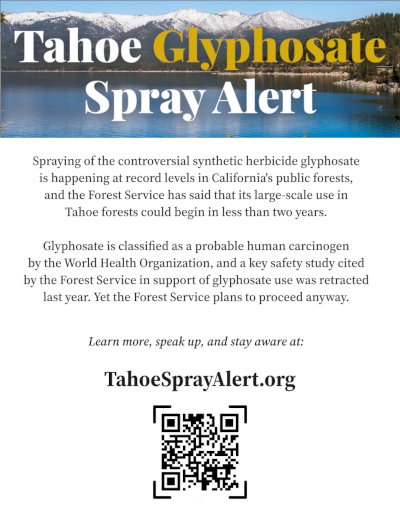
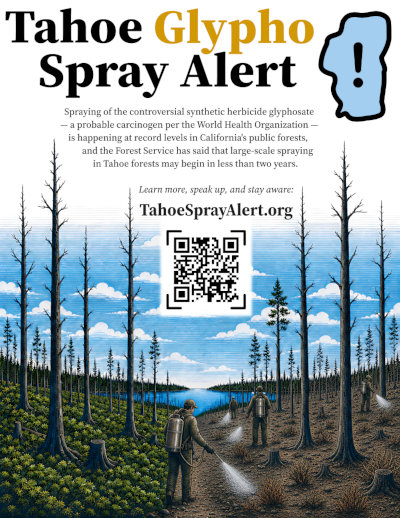
The TRPA already "discourages" herbicide use in the Lake Tahoe Basin — but discouragement is EASILY ignored. To stop the Forest Service's planned large-scale spraying of herbicides linked to cancer and environmental harm, a full ban on glyphosate and other synthetic herbicides is required. Here's how you can help:
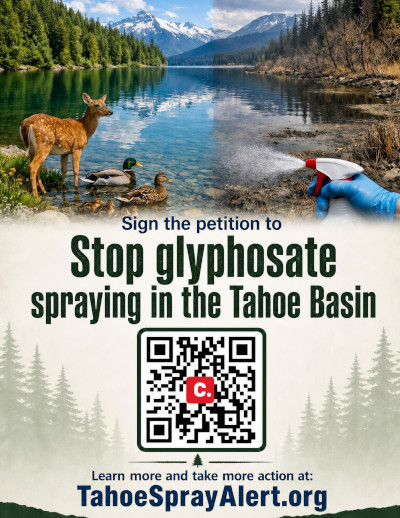
- Sign a Petition EASY
- Attend a Meeting AUGUST 26
- Contact elected officials and organizations IMPORTANT
- Post about this issue on any social media
- Raise awareness among neighbors with a yard sign
- Post or hand out flyers
- Join our email list
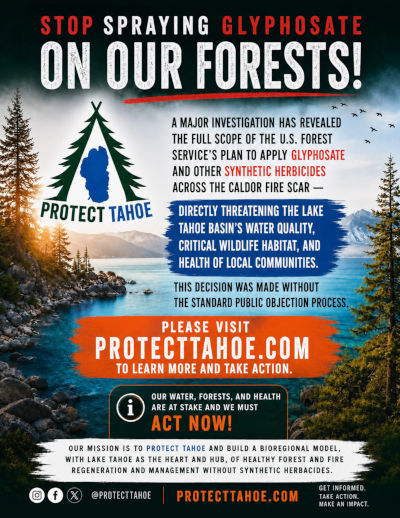
- Follow @ProtectTahoe (that's not us) on Instagram
- Street protests (future)
- Worker health warnings (future)
- Tell us ideas to add here
Worst Case
If the Forest Service Sprays
For those who want to limit their glyphosate/herbicide exposure:
Some Immediate Concerns
- 1 Recreation: If you regularly use trails in the "Project Area" (Saxon Creek Trail / Mr Toads, Cowboy Hat Trail, Oneidas / Fountain Place / Corral Trail, Armstrong Connector, Warr Trail, Osgood Swamp area, Old Meyers Grade, Rainbow Tract, some Christmas Valley trails, etc) consider adjusting your route to avoid areas with little or no vegetation, which may indicate herbicide treatment. Especially avoid walking off trail in those areas. Also be cautious hiking or biking in groups, where those in the rear may be breathing in dust kicked up by those ahead. And use your best judgment about being near treated areas on windy days.
- 2 Dog walking: It's difficult to prevent dogs from sniffing treated bushes or walking on treated ground, so try to be aware of and avoid herbicide-treated areas altogether when walking your dog. Listen to or read the KQED interview for one dog owner's experience.
-
3
Foraging: Glyphosate doesn't kill mushrooms, so they may be growing in treated areas,
and mushrooms can take up and retain glyphosate. Be especially cautious if little else is growing
where you're foraging. The investigator who broke this story was actually a mushroom forager —
hear about that in the
CapRadio podcast.
Warning signs: The Forest Service has stated they'll put up "cautionary" signs with a warning that plant products should not be gathered for food/medicine for 30 days. However, such signs may only be up for 48 hours, and likely won't show the spray perimeter. - 4 Home air: If you live near a treatment area, an air purifier may be a wise precaution. Look for filters that trap chemical gases and/or herbicide-laden dust, according to your concern(s).
*Long term exposure concerns are beyond the scope of this website.
Reference
Project Maps
USFS-provided maps can be found here. However, there are 31 of them and they're in PDF format. In an effort to make the two most herbicide-related PDF maps more accessible, we've overlaid their boundaries onto a digital map.
IMPORTANT NOTES
- a. Our map overlay is approximate. For accurate boundaries, only rely on the Forest Service maps.
- b. Map boundaries cannnot account for the spread of glyphosate and/or other herbicides through dust, wind and precipitation runoff.
- c. The Forest Service has not provided maps of planned herbicide application areas, so it's impossible to know where "reforestation" will mean years of synthetic herbicide spraying.
- d. What the Forest Service maps call "reforestation" is more accurately described as "deforestation followed by unnatural reforestation". The forest has already been regenerating itself for five years, and the Forest Service plan involves first removing that natural regeneration, including the diverse understory of native plants and well-established conifer seedlings.
- e. If the "project area" seems small: 1) compare it to the size and proximity to the City of SLT, and 2) understand that decisions made here will likely influence future herbicide decisions throughout the Tahoe Basin.
Reference Links
Forest Service Documents
Reference
Definitions
Foliar spray means spraying herbicide directly onto the leaves (foliage) of plants rather than onto the soil or applying it to cut stumps. The herbicide is absorbed through the leaves and travels through the plant's system, killing it from the inside out.
In the context of Tahoe/Caldor herbicide applications, foliar spraying means workers will use backpack sprayers to coat the leaves of target plants — in this case the forest's natural regeneration (including native plants) they want to eliminate before replanting.
The obvious concern with foliar spraying in a mountain environment is that the spray can drift, landing on non-target vegetation, soil, water, and potentially reaching wildlife and people.
This means herbicide is applied around the base of a plant stem rather than sprayed over the whole plant.
Cut stump treatment is exactly what it sounds like — a plant or tree is cut down, then herbicide is applied directly to the freshly cut stump within minutes (before the plant's vascular system closes up). The herbicide is absorbed through the cut surface and travels down into the root system, killing it and preventing regrowth. Repeated treatments are often needed if the root system is strong.
This sounds like a very precise sprayer, but actually "calibrated" just means the flow rate is set — it says nothing about actual volume of herbicide being sprayed.
Riparian refers to the lush, transitional zones of vegetation and soil located along the edges of rivers, streams, creeks, lakes, and wetlands. These are critically important areas. But in the context of this issue, it's important to remember that virtually all precipitation that falls in the Tahoe Basin eventually flows to Lake Tahoe. Worth noting too is that the Forest Service has previously been cited for water quality violations at five Lake Tahoe projects, with several violations causing significant erosion into Lake Tahoe streams. And with glyphosate and other synthetic herbicides being virtually invisible, the potential for herbicide contamination of Lake Tahoe's watershed is alarming.
Regarding any assurances of "water monitoring" to detect herbicide contamination... well, once synthetic herbicide is detected downhill from the 2,400–3,600 acres it was sprayed on, then what?
Chaparral refers to a shrub-dominated ecosystem. The vast majority of plants in the Tahoe/Caldor chaparral are NATIVE species like manzanita, whitethorn, and snowbrush. Do a search on the fire-activation characteristics of any of these plants — you will be amazed. For example, snowbrush seeds can lie dormant for 200 years waiting for a fire comes through. Because of its deep root system and the canopy it provides, chaparral is vital for soil conservation, preventing erosion, and protecting our mountain watershed from debris flows (especially important after fire). Chaparral also supports unique biodiversity, and in our case is already housing numerous birds and mammals like deer, coyotes, and bobcats. Moreover, a walk through the Tahoe/Caldor chaparral quickly reveals that it's providing an extremely valuable function in preventing conifers from growing too closely together, mitigating future fire risk. But rest assured, conifers are definitely growing. You can go look!
In the years immediately after the Caldor fire, the burn scar in Tahoe was dominated by wildflowers and small plants. Just five years later, it's currently dominated by chaparral. In time, as the conifers grow and begin shading out the chaparral, they will once again dominate — as nature intends. But for now, chaparral is what nature intends.
Nature moves through phases. It would be wonderful to have wildflowers all the time, or giant trees all the time — but walk through the Tahoe/Caldor area now and you'll see that this phase is also amazing. And beautiful. And vital. It is not, as the Forest Service calls it, "deterioration."
In an email dated June 11, 2026, the USFS LTBMU wrote "Application of herbicides will be targeted, applied with calibrated backpack sprayers as a direct foliar spray, or by other low-volume methods such as cut stump, basal bark spray, and thinline application."
1) "Targeted" sounds reassuring, but with spray work likely contracted out to private companies
and their hired crews, there's no guarantee this will look the way it sounds on paper.
2) "Or by other..." is notably open-ended, leaving the door open for methods beyond what's listed.
3) "Low volume" is extremely vague. It tells us nothing about actual quantities —
and the Forest Service has made no disclosure on the total volume of synthetic herbicide to be sprayed in the Tahoe Basin.
The volume is what matters, not words.
Opinions seen on NextDoor, Facebook & Instagram